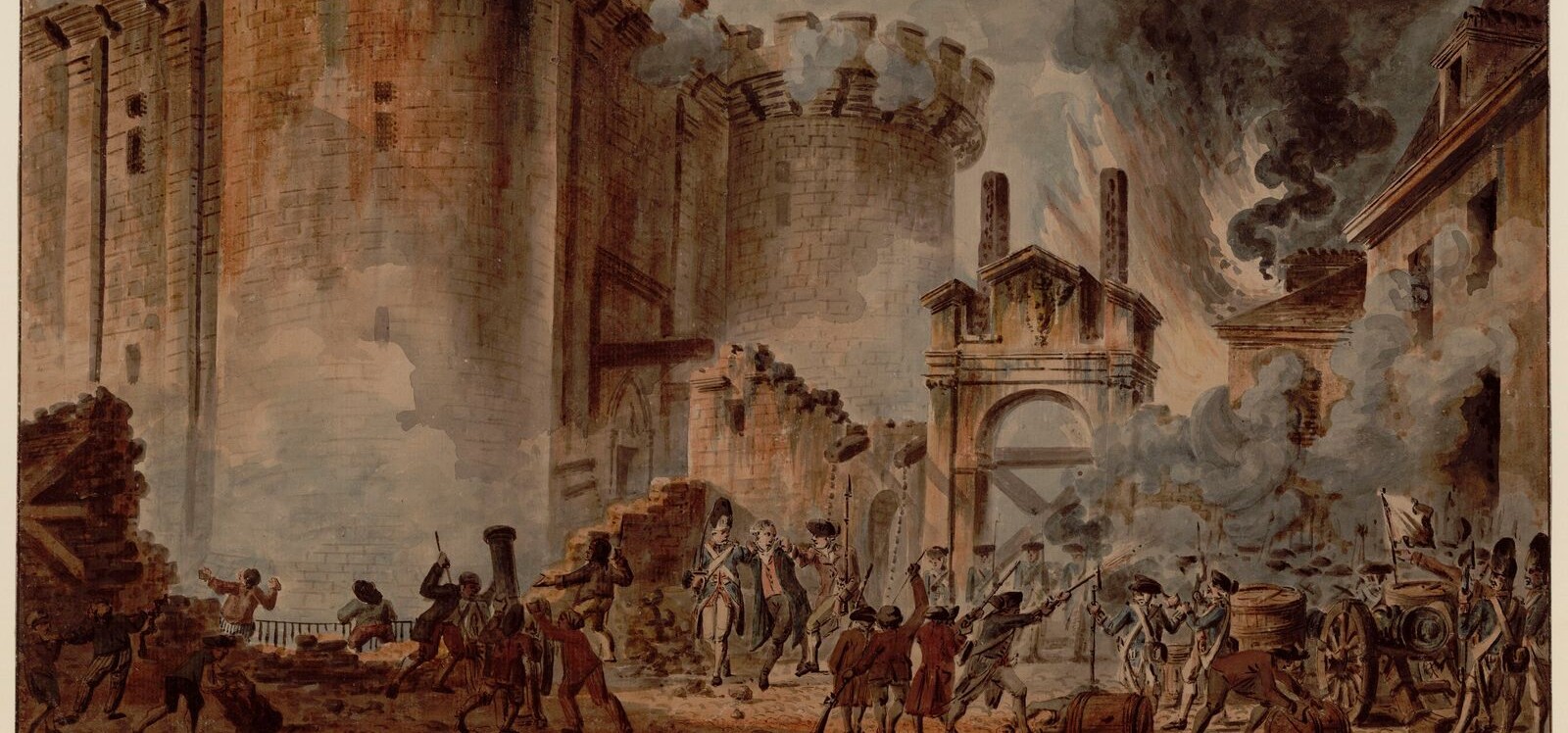
Or, how a symbol can unite even when it divides
On July 14, 1789, the people of Paris stormed the Bastille — a medieval fortress casting the heavy shadow of the past, and of its own enormous bulk, over the heart of the City of Light. In its modern role (French historiography calls "modern" the period from the second fall of Constantinople to the date that opens this sentence, and calls the era from then to today "contemporary"), the Bastille was a grim prison, in whose dungeons the political opponents of royal absolutism were tortured. Accordingly, quite logically, the brave revolutionaries inspiredly stormed the dark symbol of unchecked despotism's arbitrary rule, overcame its bloodthirsty garrison, and freed the tormented and tortured prisoners. Whereupon the triumphant citizens tore down, stone by stone, with their bare hands (and if possible that very same day), the wicked fortress-prison, and in its place planted a sign reading, "Dancing here." This is the story nearly all of us in the civilized world have grown up with over the last two centuries. It has the undeniable advantage of being instructive, clear, and virtuous, like a modern children's fable. And it is just as true.
What Actually Happened on July 14, 1789, and Why?
On May 5 of that year, King Louis XVI solemnly opened the Estates-General, which he had summoned a few months earlier on the advice of his finance minister, Necker. This was made necessary by the enormous budget deficit that had brought the state to the brink of possible bankruptcy. The paradox is that France had an economy that had been growing continuously, sensibly managed, with a balanced fiscal position from the 1720s right up until the eve of the revolution. Misery and poverty were appalling by our modern standards, but were declining fairly steadily and were many times lower than in a Spain, an Austria (excluding Lombardy and the Austrian Netherlands), or a Venice — not to mention compared with social catastrophes like the Ottoman Empire, Russia, or the Kingdom of the Two Sicilies. France was the country holding half of all the money in circulation in Europe, as the aforementioned Necker put it, even before he became a minister. Despite this picture, the French state faced a financial catastrophe, and — contrary to another children's fable we grew up with — this was not due to the cost of maintaining the court or the extravagance of Queen Marie-Antoinette. Both were significant, but entirely comparable to the economic weight of the senior state apparatus and protocol of any large representative democracy today. The main problems that, according to most serious historians, led to the budgetary impasse that forced the summoning of the Estates-General — and so opened the door to revolution — were three.
A Volcano
The first can be called objective. The gigantic eruption of an Icelandic volcano in 1783 caused a reduction in summer sunlight and a series of dreadfully polar winters across all of Western Europe, resulting in a string of catastrophically poor harvests. Because royal and other tax officials of the second half of the 18th century did not resemble their thuggish predecessors of the start of the previous one (and even less their degenerate Soviet equivalents of the 1920s and '30s), but were, on the whole, rather humane and cultured Enlightenment men, incapable of carrying out mass killing by starvation, tax revenues from agricultural regions collapsed.
A War
The second problem was situational. Again in 1783, France emerged victorious from the war in which it secured the independence of the United States of America. It did so through brilliant diplomacy, managing to achieve the near-complete European isolation of Great Britain, as well as through a navy that, for the first and second-to-last time (the next being today) within two centuries, was larger and better than Britain's. This naval supremacy cost it dearly, fatally so, because France did not have the dividends of the monstrous industry and trade of its sister-enemy across the Channel that would have allowed it to afford this.
A Regime
The last and most important problem was of a serious, systemic order. The great problem of the Old Regime was that it was forced, by its own structure and traditions, to seek funds where they often did not exist, and was unable to collect them from at least a third of those who had them. The puzzle became unsolvable because of the extremely weak state power, weak compared to any modern system. The French monarchy was absolute not because of some often-imagined unlimited power of the monarch, but because absolutely all authority within it derived from the king. Accordingly, over the millennium-long development of society from that Frankish barbarism which swept away the Roman Empire in Gaul, to the kingdom that restored Philosophy's place in European civilization in the 18th century, all manner of brakes accumulated from every direction, so that the origin of power could never simply merge with its exercise — which in turn would have eaten away at the very foundations of society. The king held a great deal of power in his capacity as what we would today call the executive branch, and in his role as military commander. As legislator, however, he ran up against every kind of traditional, estate-based, ecclesiastical, provincial, and communal dike, wall, and beam standing in the way of his action. Except in wartime, and only for its duration, the French king could not impose new taxes, nor tax groups of people whom royal charters or tradition had exempted from the tax burden at some point in the distant or recent past. Such were, of course, the Church and the nobility, but also certain guilds, individual towns, and even some villages. And of course, wherever neither the government — "the Council in the Presence of the King" (Le Conseil, dans la Présence du Roi) — nor the ordinary legislator — "the King in his Councils" (Le Roi dans ses Conseils) — could act, someone had to be able to.
The Estates-General
And here comes the thing that might be described as "the King together with the three estates of the kingdom he had summoned, in the person of their elected extraordinary representatives" called the Estates-General (Les États Généraux). It was precisely the summoning of this body that Necker recommended to Louis XVI as a tool for dealing with the deficit. The drama's turning point came when, in less than a month, the representatives of the Third Estate declared that they, and they alone, as elected by the overwhelming majority of the people, represented the entire nation — and that it was the nation, not the monarch, that was the source of all power in the state. After a failed attempt by the crown to dissolve them, they declared themselves the National Constituent Assembly and swore to remain together until they had drafted and adopted a new Constitution. How did the king react? Quite logically. Like a man prescribed medicine for a toothache that gave him diarrhea, without any prospect of improving the state of the tooth, he decided to change doctors. He dismissed Necker. The problem was that, in the meantime, a large part of the Parisians, inspired by what was happening at Versailles (where the royal family, the court, the ministers, and the Estates-General — now transformed into the self-constituted National Assembly — were located), had come to see in the dull finance minister their own French Washington. By the end of the revolution, they would successively see the French Washington in Mirabeau, Lafayette, Brissot, Danton, Robespierre, Dumouriez, the Abbé Sieyès, and Napoleon Bonaparte. The last would prove best suited to the role — but would finish it off in the version of a "new Octavian Augustus," together with the revolution itself. In the summer of 1789, however, the hero was Necker. And it was precisely him that the king managed to dismiss at the start of July.
The Uprising
A mass protest by Parisians followed, in defense of the unexpected tribune of the people. Crowds gathered in the capital, preparing to march on Versailles to explain to their good king (good for another two years, until his attempted flight) that he was being badly advised by his wicked brothers and his depraved Austrian bitch (this being the most polite way these Parisians referred to their queen at the time), and that he absolutely must return the good Necker-Washington to power. In response, Louis XVI concentrated several of his most reliable regiments around Paris, with explicit orders not to engage, in a clumsy attempt to cool his loyal capital's desire to march on Versailles. The effect, naturally, was the opposite of the one intended. The Parisians indeed never reached the king's residence, but began arming themselves hysterically, having largely come to believe a rumor claiming the regiments had been sent by the "filthy Austrian" to massacre them. Having looted every weapons shop in the city, they turned to the two large sites used by the French army as arms and ammunition depots. Muskets and cannon were kept at the Invalides, while a very serious quantity of gunpowder was kept at the Bastille. On the 14th, the Parisians laid siege to both. The Invalides fell without a fight; the Bastille did not. The commandant decided that an enraged, armed mob attempting to seize the fortress entrusted to him and firing on his soldiers was good enough reason to order return fire, including artillery. He surrendered once the cannon brought from the Invalides answered his own. He was killed immediately, along with all his officers. As, on that same day, were all the city's police officers who could be identified as such (the police at the time were purely plainclothes; the uniformed force had not yet been invented). The same fate befell the representatives of the municipal authority then in power, starting with the Provost of the Merchants (as the office of the mayor of Paris was officially titled up to that memorable day). The heads of all these people were cut off, mounted on pikes, and paraded through the city by the victorious defenders of liberty. Besides being an army powder magazine, the Bastille was indeed also a prison — but for close to a century it had been a five-star one, reserved for mildly errant or thoroughly mad aristocrats. The triumphant crowd freed its only seven prisoners and carried them through the streets. Among them was the Marquis de Sade (the one whose name gave rise to the word "sadism"), as well as one man sincerely convinced he was Julius Caesar. Neither that day nor in the months that followed did anyone think of the Bastille as a fallen symbol of absolutism.
The Fête de la Fédération
But when, the following year — 1790 — the Fête de la Fédération was organized (that is, the official marriage between the king and the nation, and the merging of the aristocracy with the rest of the people), Lafayette insisted it be held on July 14 — on the anniversary of the day the Revolution seized power by force in Paris and forced the monarchy to speak to it as an equal. The king's signing of the Declaration of the Rights of Man and of the Citizen was a direct consequence of that day. The king would no longer be the source of all power in the Kingdom. The reading given by the "Hero of Two Worlds," Lafayette, of July 14, 1789, is not only the most accurate but also the most honest one possible. Before countersigning one of the most significant documents in human history, and before publicly swallowing the transformation of the "Estates-General" into the "National Constituent Assembly," Louis XVI was forced to accept the creation of a military force parallel to his own army, and to appoint as its first commander... the Marquis de Lafayette. Thus was born the National Guard, which would outlive both the king and its own commander (who, incidentally, would be appointed to lead it once again by the last French king, one exile, one republic, one emperor, and two monarchs later). For a long time, it would also be the product of July 14 with perhaps the most direct impact on building a nation of citizens in place of the old mosaic of mutually blocking estates. It bears repeating that we are talking about July 14, 1789 — and that this is not the day the Bastille fell, but the day the armed people of Paris most brutally seized power, physically eliminating every agent and representative of the Old Regime found in the city. The armed Parisians would prove decisive in every major political change in the country over the following 82 years, and their National Guard would become the backbone of every revolution, every coup, every change of regime... They would hold every subsequent government hostage, periodically reminding it that, however indisputable and firmly established the principle of national sovereignty might now be, nothing predetermined what, who, and how best expressed it. Was the optimum the Emperor, who seized power in a military coup after brilliant victories over his enemies and governed by plebiscite? Or were the deputies, elected directly and by majority vote, with or without a property qualification, the best and most sensible solution? And why, then, should the assembled armed men of the country's largest and most significant city — the inevitable seat of all power — not be the truest and most natural expression and representative of the will of the entire nation? Is this not, after all, historically the oldest model of popular power, and for that reason more legitimate than the other two? It is this rather ancient-Roman game of thrones, in essence, that France played out for most of the 19th century, swinging the whole while between empire, constitutional monarchy, and republic as forms of government. The last of these should truly be understood in its etymological sense — or, to paraphrase the conclusion Louis Barthou would reach in the following century, as the choice of one garment over another. The real dilemma of power is the one described above, and it would end very badly for the armed people of Paris and their National Guard. In the midst of one of modern France's three national catastrophes, the City rose up once again, once more asserting its claim to represent, as hegemon, the entire nation. The year, however, was 1871 — not 1789, and not 100 BC. Nation-building had been completed, and the ancient Roman model of uniting Italy by force was incompatible with it. The Republic's provisional government sent the regular French army to seize the city and destroy its armed populace. This is not a metaphor. Around ten thousand Parisians were shot. As many again were sent into exile in Algeria. Eight years later, after MacMahon's resignation and the definitive establishment of the Republic, July 14 was adopted as a national holiday. Now came the time to pull the bloody human heads down off their pikes and turn the day into a pleasant symbol. And since France is France — even into two symbols, one for each half of the nation.
The Symbol
To this day, one in three French people will tell you that the national holiday honors July 14, 1790, and that magnificent, many-thousand-strong festival of national unity on the Champ de Mars, presided over by Lafayette and attended by the king. A second will tell you the fable this essay began with. A third will most likely just smile at you in silence. Their version of the story would most likely include the mounted heads.